Congratulations Dr. Xu!
Congratulations to Weilin Xu for successfully defending his PhD Thesis!
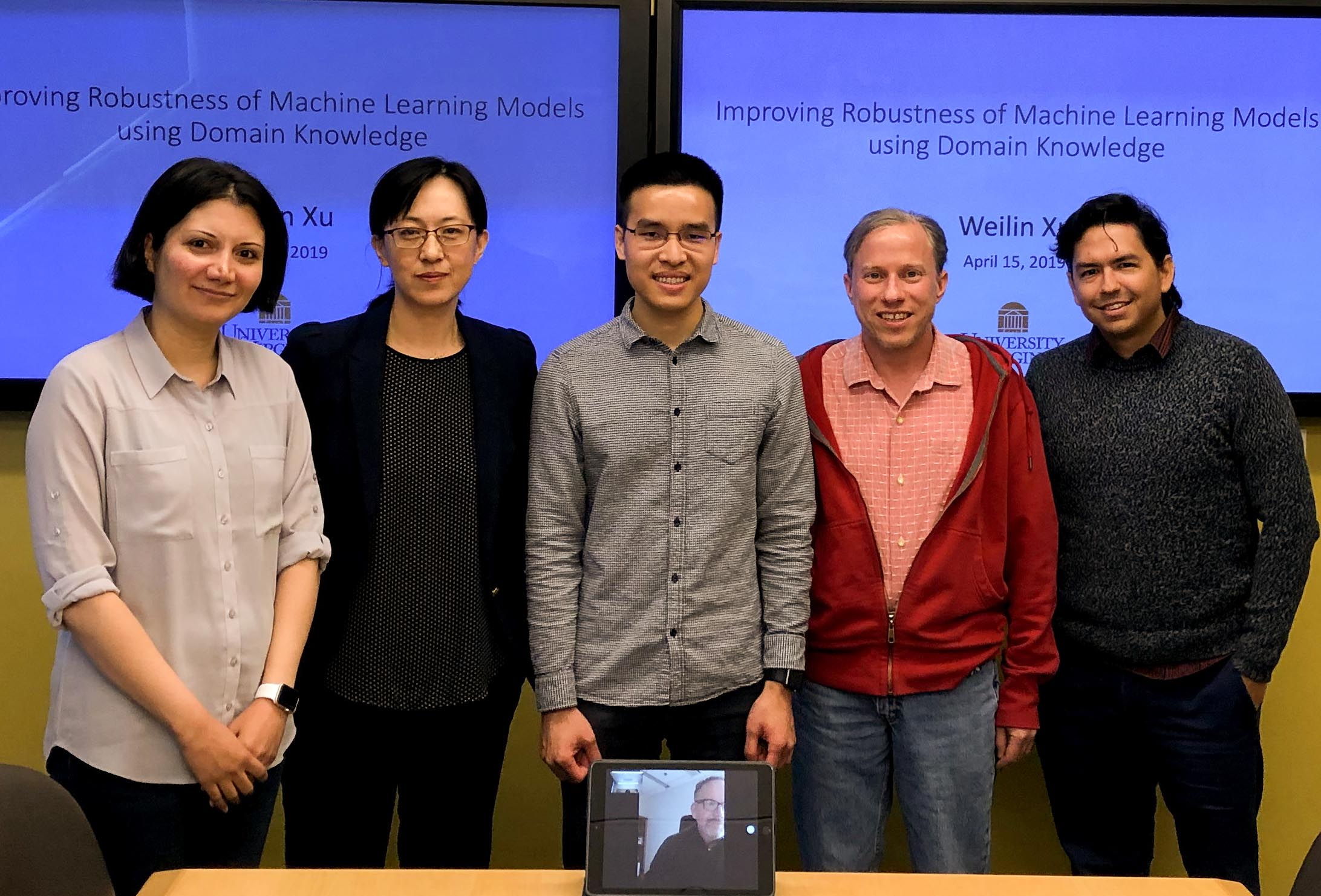
Although machine learning techniques have achieved great success in many areas, such as computer vision, natural language processing, and computer security, recent studies have shown that they are not robust under attack. A motivated adversary is often able to craft input samples that force a machine learning model to produce incorrect predictions, even if the target model achieves high accuracy on normal test inputs. This raises great concern when machine learning models are deployed for security-sensitive tasks.
Can Machine Learning Ever Be Trustworthy?
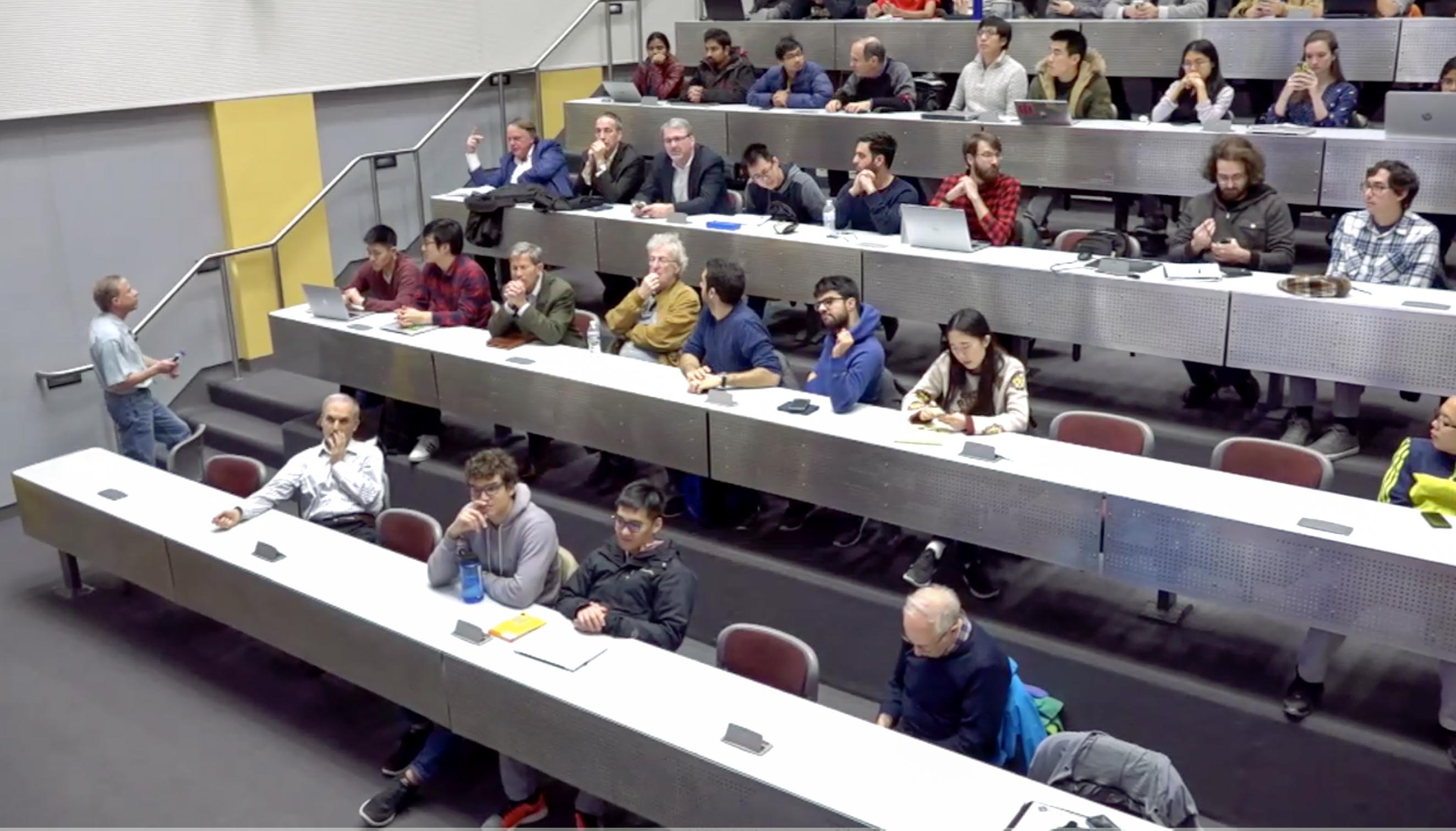
I gave the Booz Allen Hamilton Distinguished Colloquium at the University of Maryland on Can Machine Learning Ever Be Trustworthy?.
Mutually Assured Destruction and the Impending AI Apocalypse
I gave a keynote talk at USENIX Workshop of Offensive Technologies, Baltimore, Maryland, 13 August 2018.
The title and abstract are what I provided for the WOOT program, but unfortunately (or maybe fortunately for humanity!) I wasn’t able to actually figure out a talk to match the title and abstract I provided.
The history of security includes a long series of arms races, where a new technology emerges and is subsequently developed and exploited by both defenders and attackers. Over the past few years, “Artificial Intelligence” has re-emerged as a potentially transformative technology, and deep learning in particular has produced a barrage of amazing results. We are in the very early stages of understanding the potential of this technology in security, but more worryingly, seeing how it may be exploited by malicious individuals and powerful organizations. In this talk, I’ll look at what lessons might be learned from previous security arms races, consider how asymmetries in AI may be exploited by attackers and defenders, touch on some recent work in adversarial machine learning, and hopefully help progress-loving Luddites figure out how to survive in a world overrun by AI doppelgängers, GAN gangs, and gibbon-impersonating pandas.
DLS Keynote: Is 'adversarial examples' an Adversarial Example?
I gave a keynote talk at the 1st Deep Learning and Security Workshop (co-located with the 39th IEEE Symposium on Security and Privacy). San Francisco, California. 24 May 2018
Abstract
Over the past few years, there has been an explosion of research in security of machine learning and on adversarial examples in particular. Although this is in many ways a new and immature research area, the general problem of adversarial examples has been a core problem in information security for thousands of years. In this talk, I’ll look at some of the long-forgotten lessons from that quest and attempt to understand what, if anything, has changed now we are in the era of deep learning classifiers. I will survey the prevailing definitions for “adversarial examples”, argue that those definitions are unlikely to be the right ones, and raise questions about whether those definitions are leading us astray.
Lessons from the Last 3000 Years of Adversarial Examples
I spoke on Lessons from the Last 3000 Years of Adversarial Examples at Huawei’s Strategy and Technology Workshop in Shenzhen, China, 15 May 2018.
We also got to tour Huawei’s new research and development campus, under construction about 40 minutes from Shenzhen. It is pretty close to Disneyland, with its own railroad and villages themed after different European cities (Paris, Bologna, etc.).
Huawei’s New Research and Development Campus [More Pictures]
Feature Squeezing at NDSS
Weilin Xu presented Feature Squeezing: Detecting Adversarial Examples in Deep Neural Networks at the Network and Distributed System Security Symposium 2018. San Diego, CA. 21 February 2018.
Paper: Weilin Xu, David Evans, Yanjun Qi. Feature Squeezing: Detecting Adversarial Examples in Deep Neural Networks. NDSS 2018. [PDF]
Project Site: EvadeML.org