The Mismeasure of Man and Models
Evaluating Allocational Harms in Large Language Models
Blog post written by Hannah Chen
Our work considers allocational harms that arise when model predictions are used to distribute scarce resources or opportunities.
Current Bias Metrics Do Not Reliably Reflect Allocation Disparities
Several methods have been proposed to audit large language models (LLMs) for bias when used in critical decision-making, such as resume screening for hiring. Yet, these methods focus on predictions, without considering how the predictions are used to make decisions. In many settings, making decisions involve prioritizing options due to limited resource constraints. We find that prediction-based evaluation methods, which measure bias as the average performance gap (δ) in prediction outcomes, do not reliably reflect disparities in allocation decision outcomes.
Google's Trail of Crumbs
Matt Stoller published my essay on Google’s decision to abandon its Privacy Sandbox Initiative in his Big newsletter:
For more technical background on this, see Minjun’s paper: Evaluating Google’s Protected Audience Protocol in PETS 2024.
Technology: US authorities survey AI ecosystem through antitrust lens
I’m quoted in this article for the International Bar Association:
Technology: US authorities survey AI ecosystem through antitrust lens
William Roberts, IBA US Correspondent
Friday 2 August 2024
Antitrust authorities in the US are targeting the new frontier of artificial intelligence (AI) for potential enforcement action.…
Jonathan Kanter, Assistant Attorney General for the Antitrust Division of the DoJ, warns that the government sees ‘structures and trends in AI that should give us pause’. He says that AI relies on massive amounts of data and computing power, which can give already dominant companies a substantial advantage. ‘Powerful network and feedback effects’ may enable dominant companies to control these new markets, Kanter adds.
John Guttag Birthday Celebration
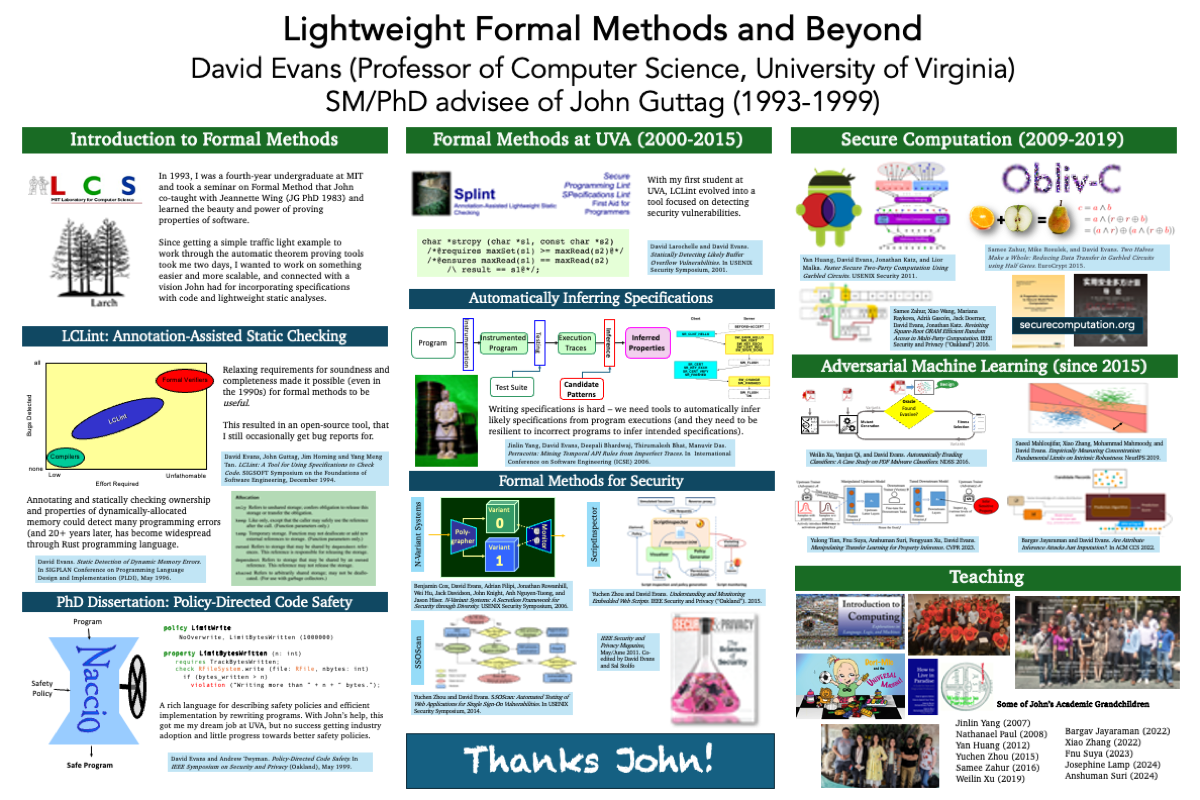
Maggie Makar organized a celebration for the 75th birthday of my PhD advisor, John Guttag.
I wasn’t able to attend in person, unfortunately, but the occasion provided an opportunity to create a poster that looks back on what I’ve done since I started working with John over 30 years ago.
SaTML Talk: SoK: Pitfalls in Evaluating Black-Box Attacks
Anshuman Suri’s talk at IEEE Conference on Secure and Trustworthy Machine Learning (SaTML) is now available:
See the earlier blog post for more on the work, and the paper at https://arxiv.org/abs/2310.17534.
SoK: Pitfalls in Evaluating Black-Box Attacks
Post by Anshuman Suri and Fnu Suya
Much research has studied black-box attacks on image classifiers, where adversaries generate adversarial examples against unknown target models without having access to their internal information. Our analysis of over 164 attacks (published in 102 major security, machine learning and security conferences) shows how these works make different assumptions about the adversary’s knowledge.
The current literature lacks cohesive organization centered around the threat model. Our SoK paper (to appear at IEEE SaTML 2024) introduces a taxonomy for systematizing these attacks and demonstrates the importance of careful evaluations that consider adversary resources and threat models.
Model-Targeted Poisoning Attacks with Provable Convergence
(Post by Sean Miller, using images adapted from Suya’s talk slides)
Data Poisoning Attacks
Machine learning models are often trained using data from untrusted sources, leaving them open to poisoning attacks where adversaries use their control over a small fraction of that training data to poison the model in a particular way.
Most work on poisoning attacks is directly driven by an attacker’s objective, where the adversary chooses poisoning points that maximize some target objective. Our work focuses on model-targeted poisoning attacks, where the adversary splits the attack into choosing a target model that satisfies the objective and then choosing poisoning points that induce the target model.