Adversarially Robust Representations
Post by Sicheng Zhu
With the rapid development of deep learning and the explosive growth of unlabeled data, representation learning is becoming increasingly important. It has made impressive applications such as pre-trained language models (e.g., BERT and GPT-3).
Popular as it is, representation learning raises concerns about the robustness of learned representations under adversarial settings. For example, how can we compare the robustness to different representations, and how can we build representations that enable robust downstream classifiers?
Intrinsic Robustness using Conditional GANs
The video of Xiao’s presentation for AISTATS 2020 is now available: Understanding the Intrinsic Robustness of Image Distributions using Conditional Generative Models
Starting with Gilmer et al. (2018), several works have demonstrated the inevitability of adversarial examples based on different assumptions about the underlying input probability space. It remains unclear, however, whether these results apply to natural image distributions. In this work, we assume the underlying data distribution is captured by some conditional generative model, and prove intrinsic robustness bounds for a general class of classifiers, which solves an open problem in Fawzi et al. (2018). Building upon the state-of-the-art conditional generative models, we study the intrinsic robustness of two common image benchmarks under l2 perturbations, and show the existence of a large gap between the robustness limits implied by our theory and the adversarial robustness achieved by current state-of-the-art robust models.
Hybrid Batch Attacks at USENIX Security 2020
Here’s the video for Suya’s presentation on Hybrid Batch Attacks at USENIX Security 2020:
Download Video [mp4]
Blog Post
Paper: [PDF] [arXiv]
NeurIPS 2019
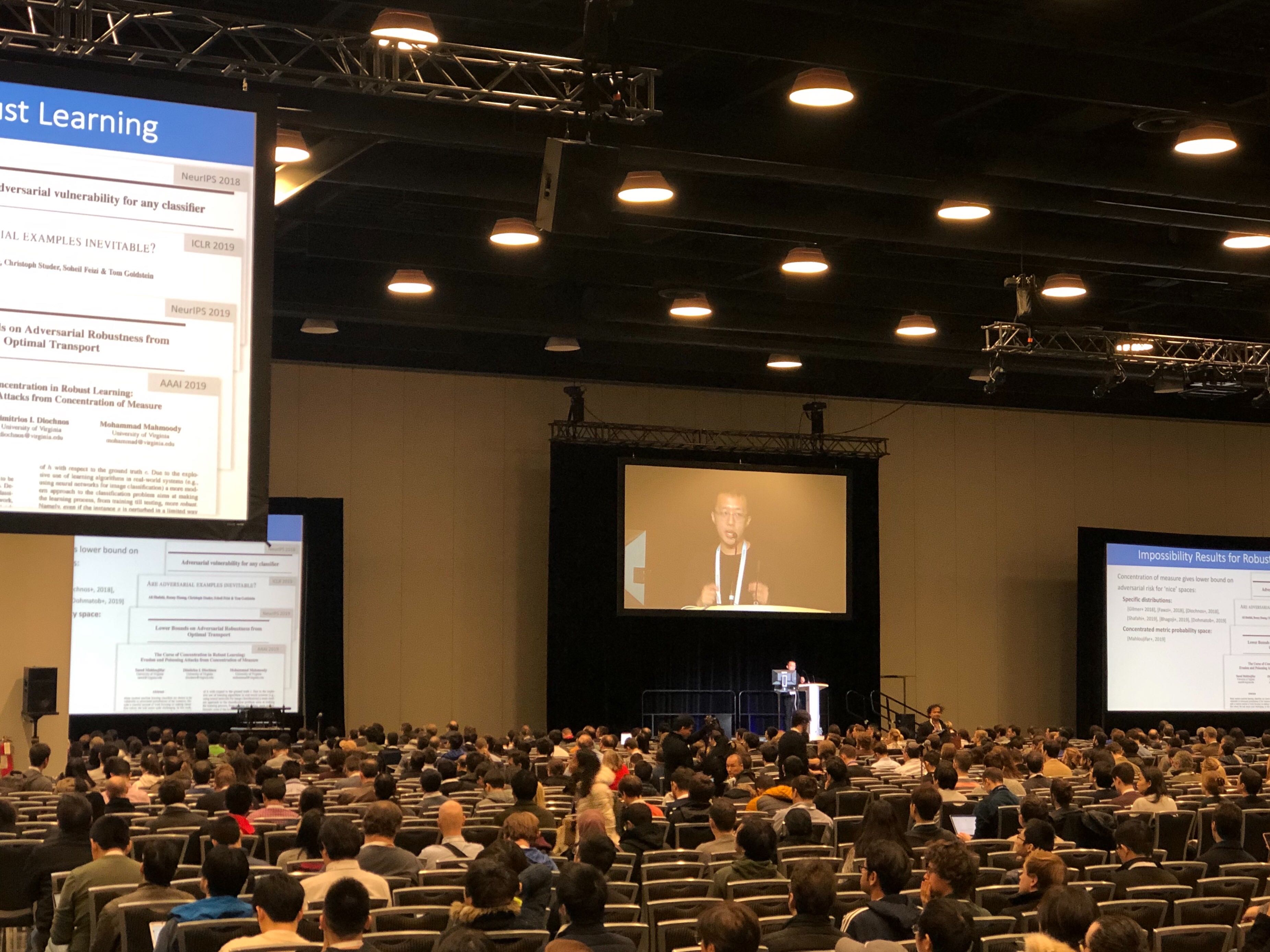
Here's a video of Xiao Zhang's presentation at NeurIPS 2019:
https://slideslive.com/38921718/track-2-session-1 (starting at 26:50)
See this post for info on the paper.
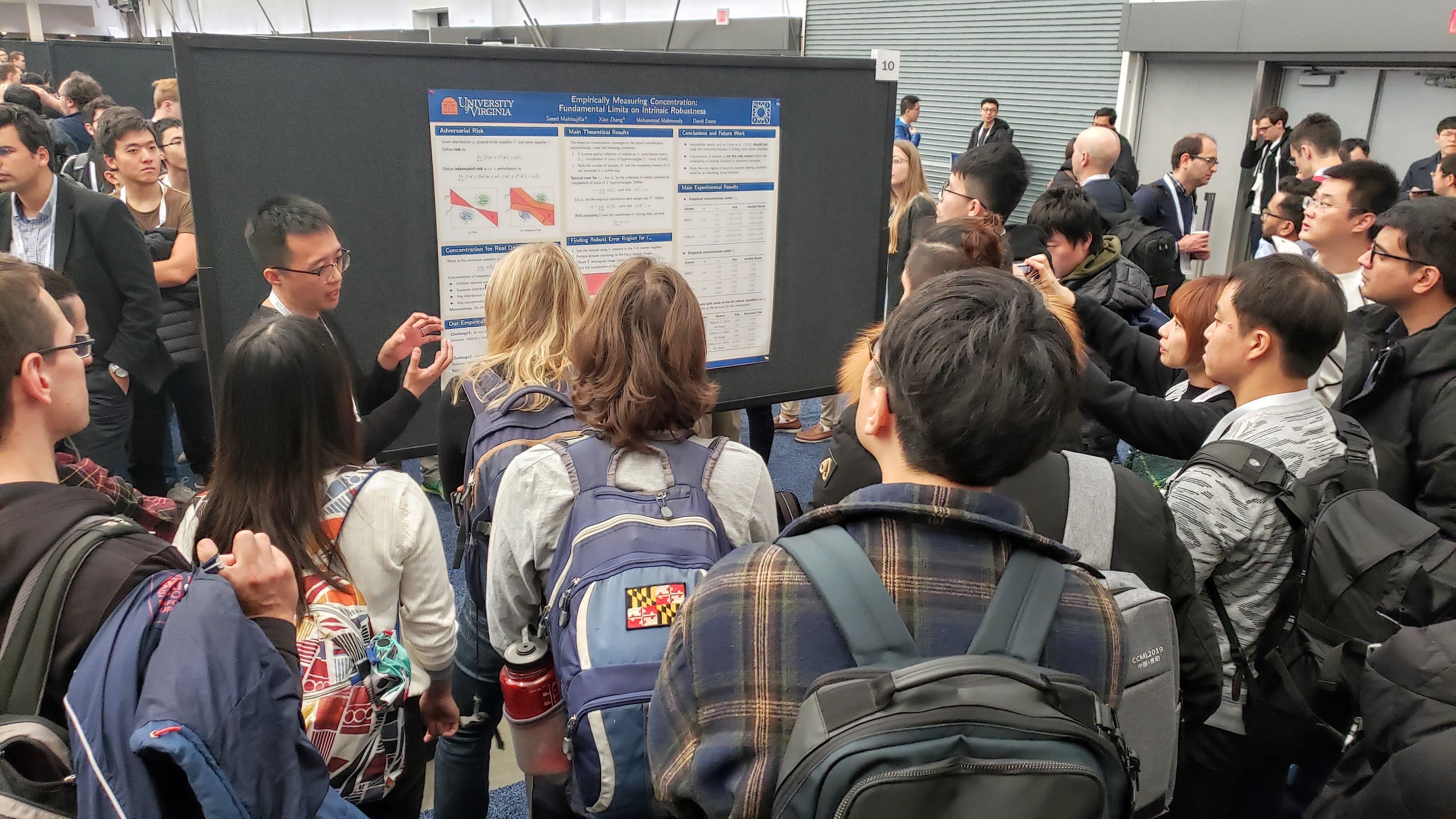
Here are a few pictures from NeurIPS 2019 (by Sicheng Zhu and Mohammad Mahmoody):

USENIX Security 2020: Hybrid Batch Attacks
New: Video Presentation
Finding Black-box Adversarial Examples with Limited Queries
Black-box attacks generate adversarial examples (AEs) against deep neural networks with only API access to the victim model.
Existing black-box attacks can be grouped into two main categories:
-
Transfer Attacks use white-box attacks on local models to find candidate adversarial examples that transfer to the target model.
-
Optimization Attacks use queries to the target model and apply optimization techniques to search for adversarial examples.
NeurIPS 2019: Empirically Measuring Concentration
Xiao Zhang will present our work (with Saeed Mahloujifar and Mohamood Mahmoody) as a spotlight at NeurIPS 2019, Vancouver, 10 December 2019.
Recent theoretical results, starting with Gilmer et al.’s Adversarial Spheres (2018), show that if inputs are drawn from a concentrated metric probability space, then adversarial examples with small perturbation are inevitable.c The key insight from this line of research is that concentration of measure gives lower bound on adversarial risk for a large collection of classifiers (e.g. imperfect classifiers with risk at least $\alpha$), which further implies the impossibility results for robust learning against adversarial examples.
Research Symposium Posters
Five students from our group presented posters at the department’s Fall Research Symposium:
Anshuman Suri's Overview TalkFOSAD Trustworthy Machine Learning Mini-Course
I taught a mini-course on Trustworthy Machine Learning at the 19th International School on Foundations of Security Analysis and Design in Bertinoro, Italy.

Slides from my three (two-hour) lectures are posted below, along with some links to relevant papers and resources.
Class 1: Introduction/Attacks
The PDF malware evasion attack is described in this paper:
Weilin Xu, Yanjun Qi, and David Evans. Automatically Evading Classifiers: A Case Study on PDF Malware Classifiers. Network and Distributed System Security Symposium (NDSS). San Diego, CA. 21-24 February 2016. [PDF] [EvadeML.org]
Class 2: Defenses
This paper describes the feature squeezing framework:
Google Security and Privacy Workshop
I presented a short talk at a workshop at Google on Adversarial ML: Closing Gaps between Theory and Practice (mostly fun for the movie of me trying to solve Google’s CAPTCHA on the last slide):
Getting the actual screencast to fit into the limited time for this talk challenged the limits of my video editing skills.

I can say with some confidence, Google does donuts much better than they do cookies!Brink Essay: AI Systems Are Complex and Fragile. Here Are Four Key Risks to Understand.
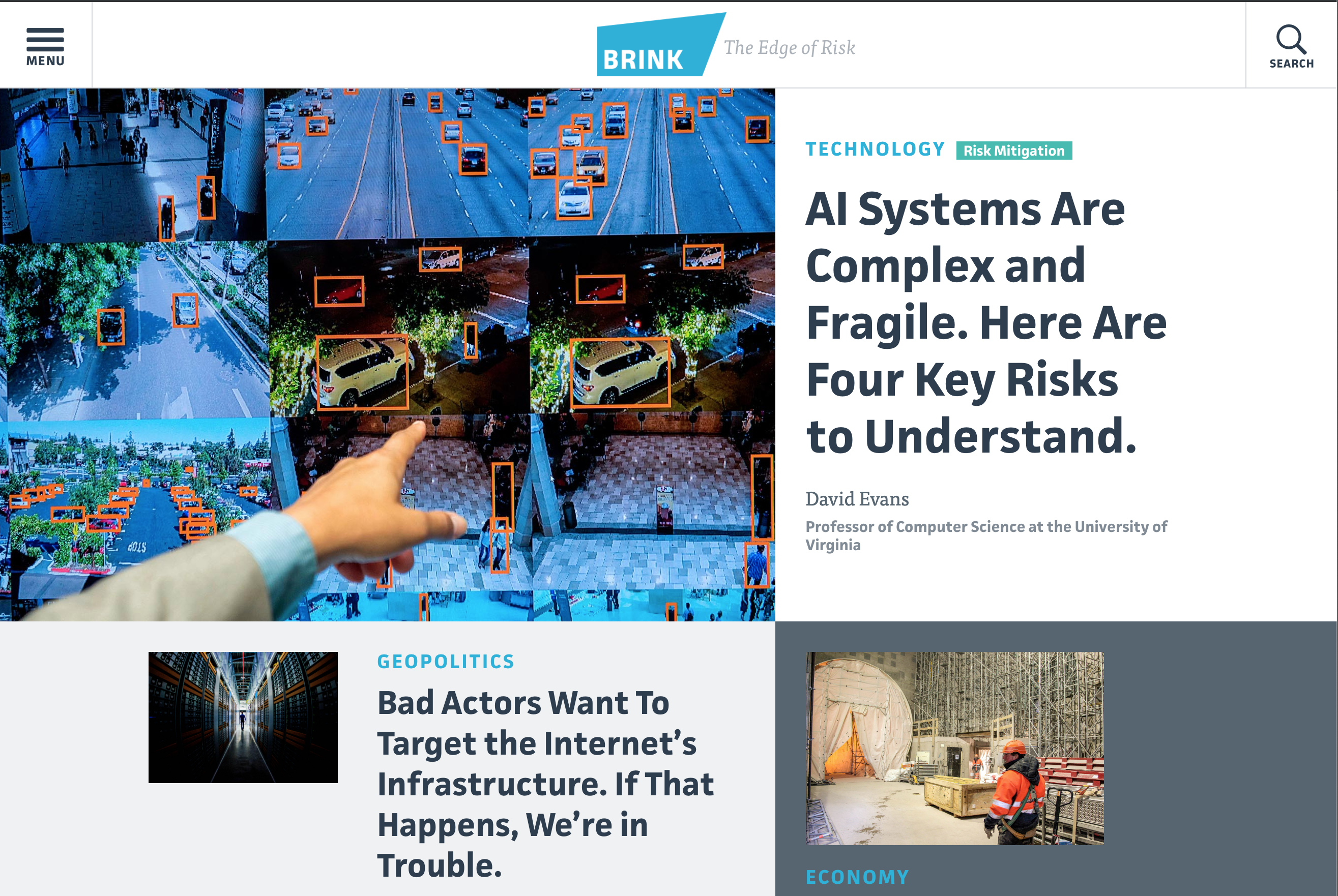
Brink News (a publication of The Atlantic) published my essay on the risks of deploying AI systems.
Artificial intelligence technologies have the potential to transform society in positive and powerful ways. Recent studies have shown computing systems that can outperform humans at numerous once-challenging tasks, ranging from performing medical diagnoses and reviewing legal contracts to playing Go and recognizing human emotions.
Despite these successes, AI systems are fundamentally fragile — and the ways they can fail are poorly understood. When AI systems are deployed to make important decisions that impact human safety and well-being, the potential risks of abuse and misbehavior are high and need to be carefully considered and mitigated.